Regulators, customers and investors are starting to ask for proof. Here's how leading companies are building it.
For seven years, Australia's Modern Slavery Act asked large companies to report. It never asked them to prove anything worked, and two in three statements lodged in 2025 did not even meet the Act's minimum requirements.¹ That is changing. Penalties, a new criminal offence and trade measures are all arriving at once. If you sign off your company's statement, the question is no longer "Did we report?" but "Can we show it worked?"
The test is no longer the quality of your report. It's the quality of your response.
15 million people in forced labour, right on our doorstep
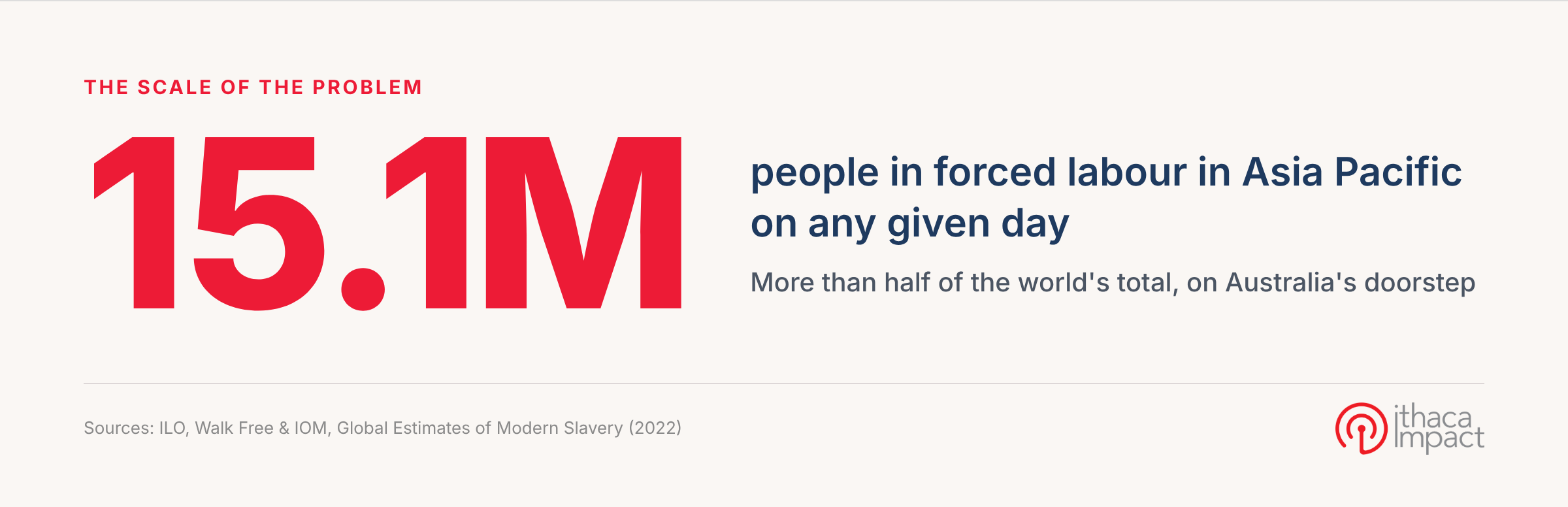
On any given day, an estimated 15.1 million people in Asia Pacific are in forced labour, more than half the world's total.² Forced labour in the region earns criminals around US$62 billion a year.³
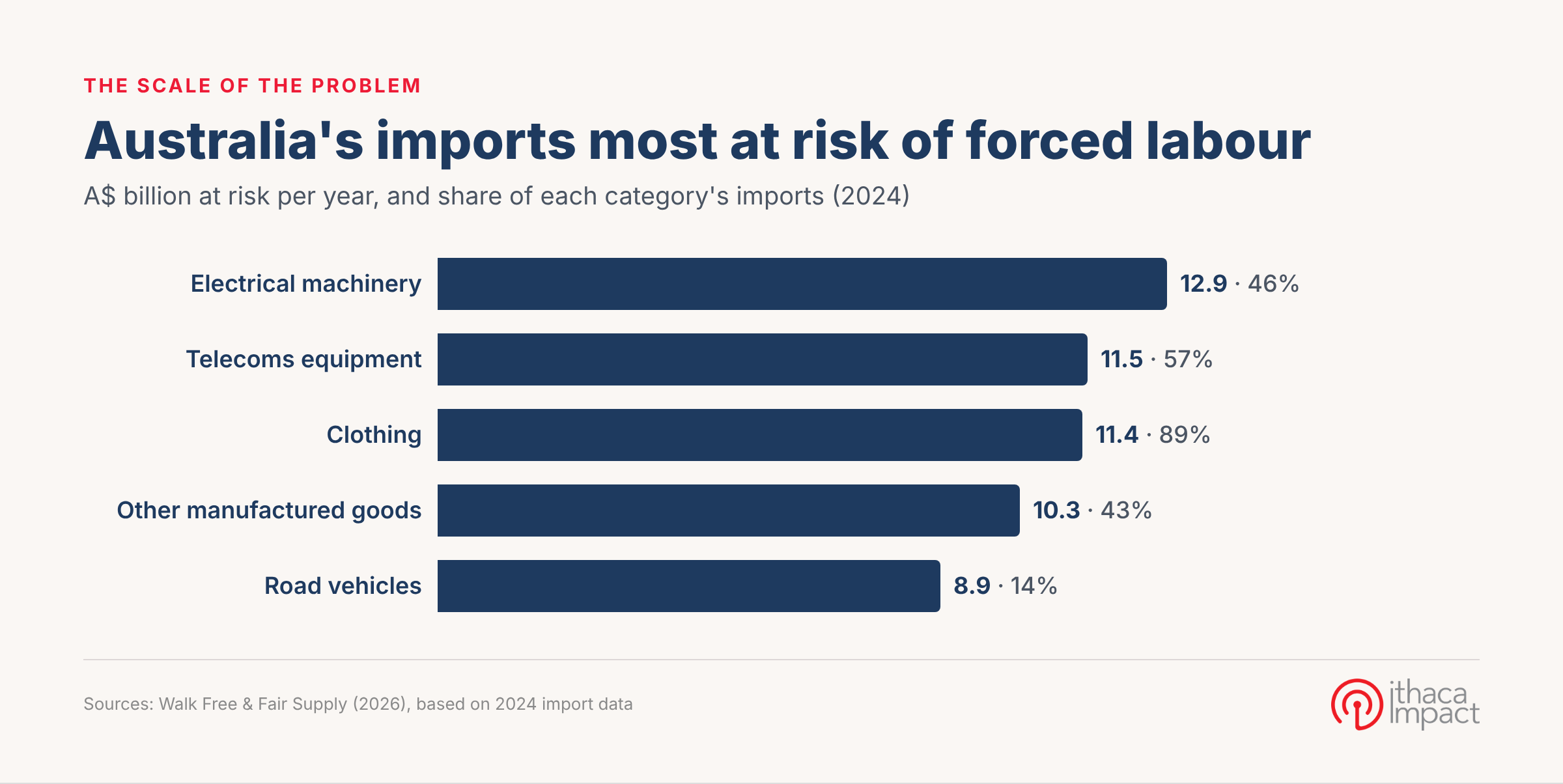
And it flows straight into Australian supply chains. Nearly A$100 billion of Australia's imports each year, one in every five dollars, is at heightened risk of forced labour. The biggest exposures are electrical goods, telecommunications equipment and clothing, mostly sourced from our own region.⁴ If you buy at scale, the question is not whether forced labour touches your supply chain, but where.
The clean energy boom adds a new layer of risk. Most of the world's polysilicon, the core material in solar panels, is linked to forced labour in Xinjiang, China. Much of the cobalt in batteries is mined in the Democratic Republic of the Congo under coercive and hazardous conditions.⁵ As Australia races to build solar farms, wind farms and battery storage, companies that can show responsible supply chains will be best placed to win contracts and community trust. A just transition must protect the people who make the equipment, not just cut emissions.
The rules are getting teeth
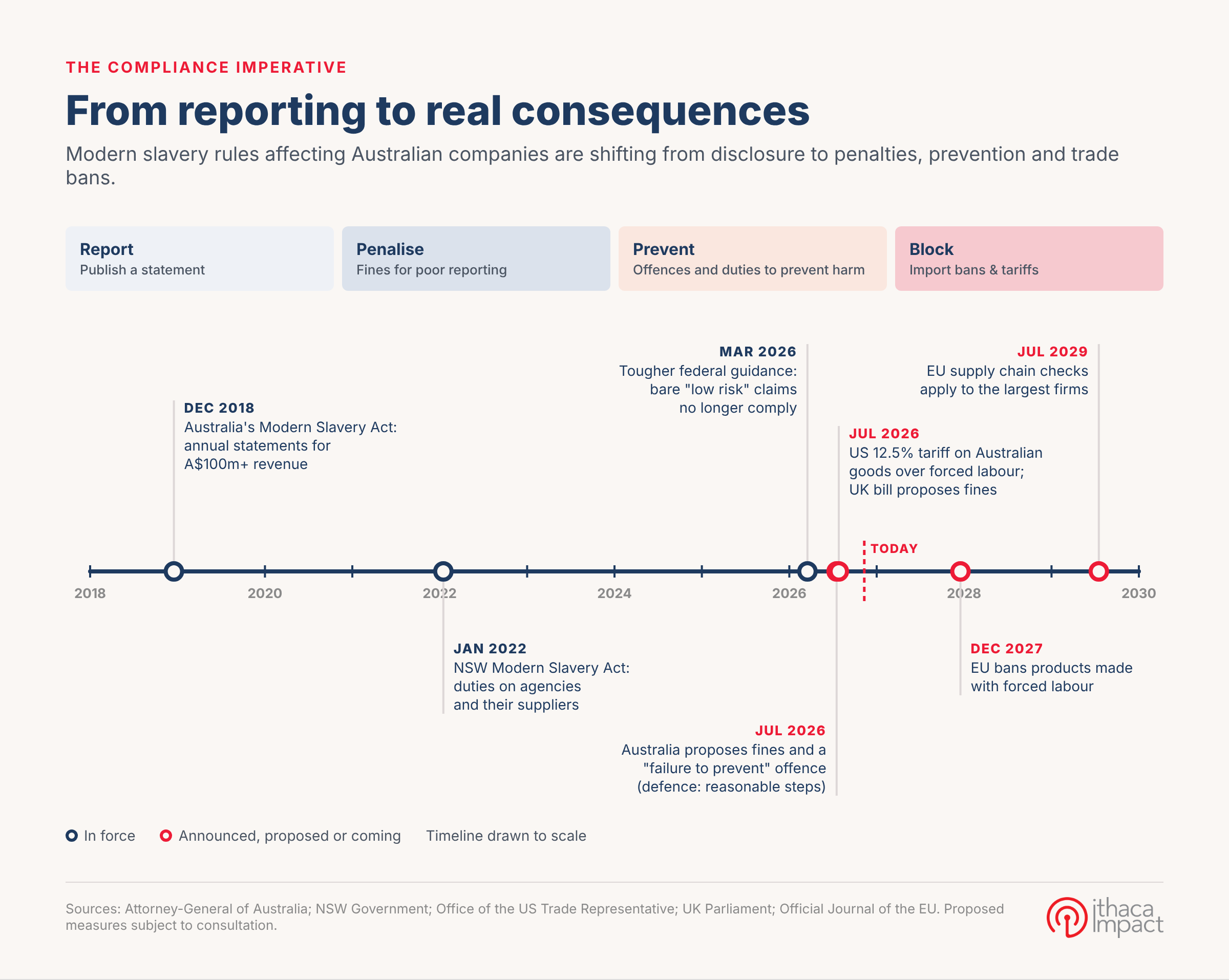
At home: In July 2026 the Australian Government announced plans for fines for companies that fail to report properly, and a proposed criminal offence of failing to prevent modern slavery for companies with revenue over $100 million.⁶ If passed, the offence would apply 12 to 18 months later. The likely defence: you took "reasonable steps".
At the border: Since 24 July 2026 the US has charged a 12.5% tariff on Australian goods, citing weak action on forced labour imports.⁷ From December 2027 the EU will ban products made with forced labour.⁸
Through your customers: Proposed UK rules (fines of up to £1 million, and more for the biggest businesses),⁹ a planned UK law requiring businesses with more than £350 million turnover to carry out human rights due diligence (no earlier than December 2027),¹⁰ and EU rules requiring large companies to check their supply chains (from 2029)¹¹ will flow down to Australian suppliers.
"Reasonable steps" will be judged on evidence, not on policies.
This is now a balance sheet issue
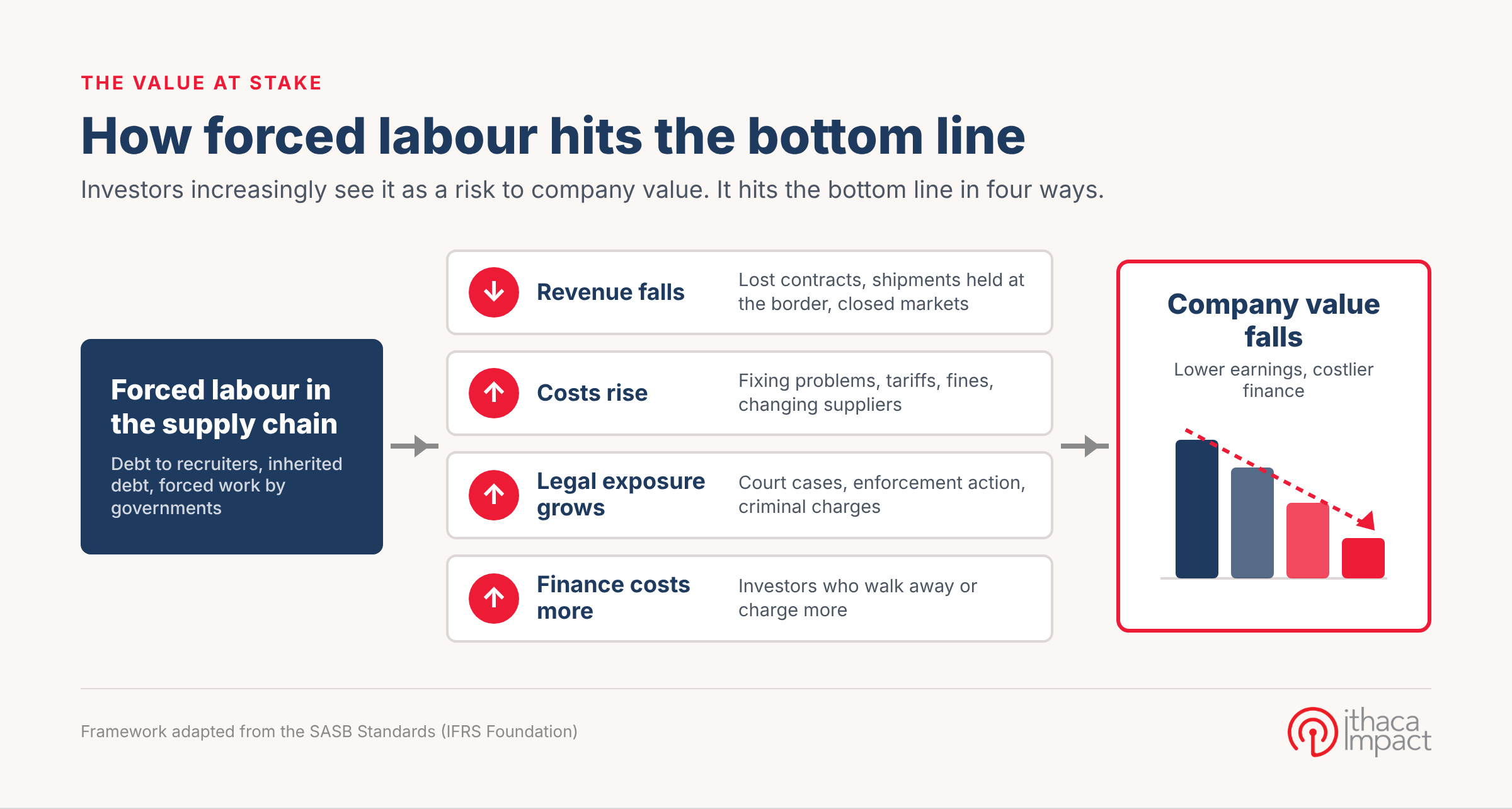
Investors increasingly see forced labour as a risk to company value. It hits the bottom line in four ways:
Revenue: lost contracts, shipments held at the border, closed markets
Costs: fixing problems, tariffs, fines
Legal exposure: court cases and enforcement action
Cost of finance: investors who walk away or charge more
Five years ago, many boards treated modern slavery as a reporting task. Today it is a financial risk. Has your risk assessment caught up?
If you need to win support inside your organisation, the financial case matters. Our team includes a holder of the IFRS Foundation's FSA Credential, which certifies expertise in linking sustainability risks to financial performance and company value. We can put the numbers in front of your CFO and board.
Behind every number is a person
Forced labour looks like a migrant worker who paid a year's wages in recruitment fees and can't leave. A fisher kept at sea for months. A family trapped in debt passed down through generations. These people make the goods we buy. Compliance is the floor. Respecting their rights is the point.
Respecting those rights takes more than a policy. It means talking with workers and the people who represent them, fixing harm when it is found, and following through until conditions actually change. Few companies are there yet: 73% of statements lodged in 2025 did not say how they would put things right for affected workers.¹ That gap is where leading companies are pulling ahead.
What the leaders do differently
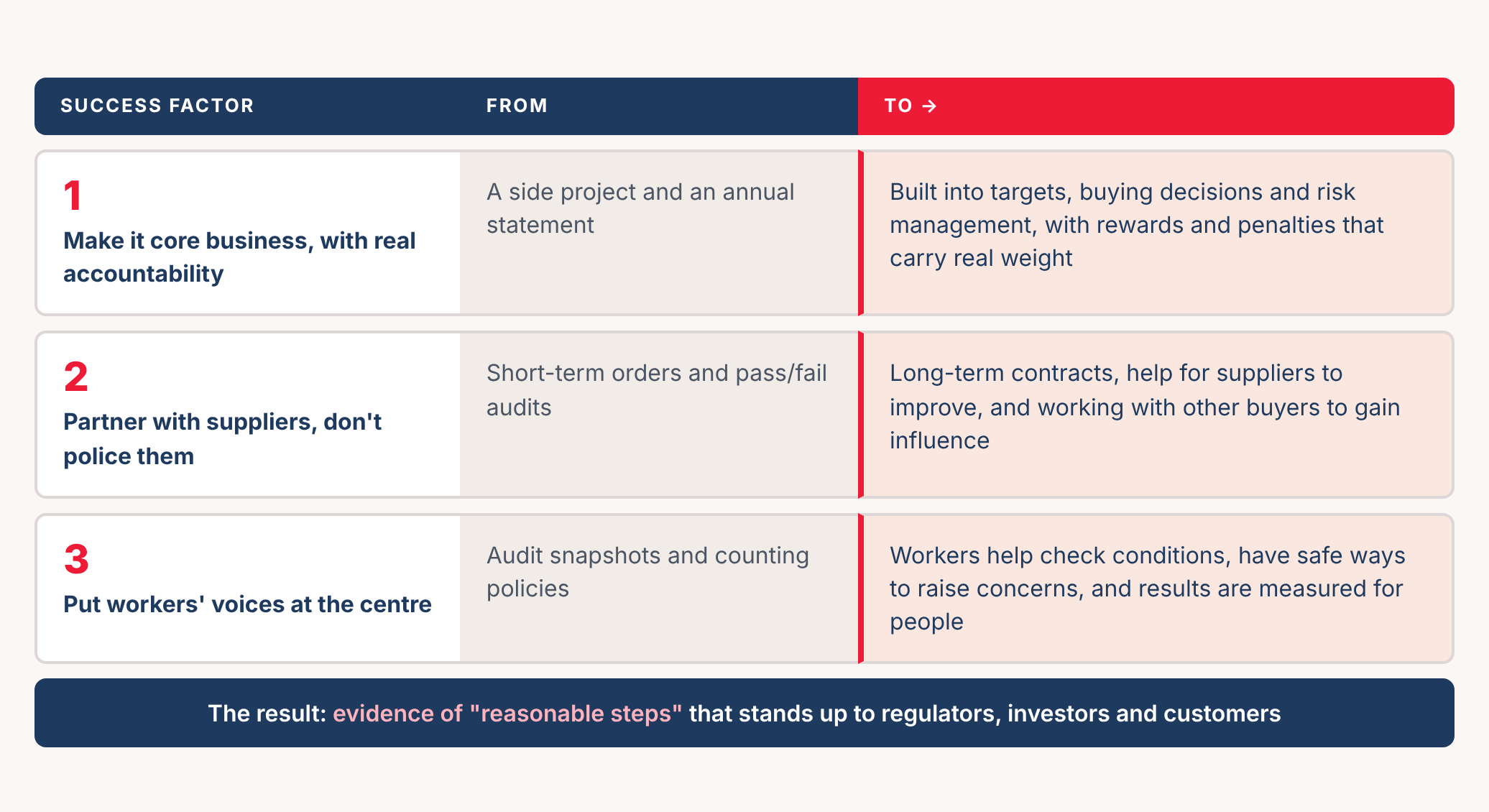
In our on-the-ground work assessing and mitigating modern slavery risks in Asia Pacific, we've found three factors that separate companies reducing exploitation from those that simply report on it.
Be ready before the regulator asks
Ithaca Impact helps large companies move from statements to evidence. We find where your biggest risks are, set up ways of working with suppliers and workers that hold up in practice, and measure results that satisfy regulators and investors.
We go beyond the desktop review. Most modern slavery assessments stop at questionnaires, risk databases and supplier self-reports. Our team works on the ground across Asia Pacific: we visit sites, speak with workers, recruiters and suppliers, and test our findings with the people affected in validation workshops before they reach your board. That is the kind of evidence a regulator will look for when it asks whether your steps were reasonable.
We don't just hand over a report. We work alongside your team to work out what effective, proportionate action looks like for your business, and help you build the capability to deliver it, one step at a time.
If modern slavery compliance sits on your desk, start with a 30-minute "reasonable steps" check. We'll look at the evidence you have today and where the gaps are, before a regulator, customer or investor asks.
Notes
Walk Free, Overdue Diligence: The case for mandatory due diligence in Australia's Modern Slavery Act (2026), drawing on the Walk Free and WikiRate review of 2025 statements
International Labour Organization, Walk Free and IOM, Global Estimates of Modern Slavery (2022); Walk Free, Global Slavery Index 2023: Asia and the Pacific
International Labour Organization, Profits and Poverty: The Economics of Forced Labour (2024)
Walk Free, Australia spends billions on imports at risk of forced labour, driving calls for urgent law reform (3 February 2026), based on Fair Supply analysis of 2024 import data
Attorney-General's Department, Strengthening Australia's response to modern slavery in supply chains, consultation paper (2026); Attorney-General of Australia, media release (16 July 2026)
Regulation (EU) 2024/3015 on prohibiting products made with forced labour, Official Journal of the EU; European Commission, Forced Labour Regulation
UK Home Office, Immigration and Asylum Bill: Modern slavery factsheet (2026); UK Parliament, Immigration and Asylum Bill 2026-27
Walk Free, UK commits to mandatory human rights due diligence to combat forced labour (November 2026); Ethical Trading Initiative, UK mandatory human rights due diligence: what businesses need to know
Directive (EU) 2026/470 amending the Corporate Sustainability Due Diligence Directive, Official Journal of the EU; European Parliament, Legislative Observatory summary